
Industrial
Process water treatment.
Recycle process water instead of using it up
In many production processes, water has traditionally been used only once and then disposed of at great expense. This applies to parts cleaning as well as to metal and plastic processing. Fresh water, disposal fees, and wear and tear on equipment drive up operating costs.
PURIMA’s industrial process water treatment reverses this flow and enables the reuse of used process water. The water undergoes multi-stage purification, is stripped of oil, grease, and particles, and is returned to the process with consistent quality. Designed according to the zero-liquid-discharge principle, this system minimizes the discharge of fresh water as much as possible. Keeping water in the cycle conserves a valuable resource and reduces the environmental impact.
We manufacture our systems from stainless steel. This ensures excellent resistance to alkaline media.
The systems have a modular design. We configure the filter stages to match the degree of contamination and flow rate of your application.
Technical Specifications
- Modular, multi-stage design based on the cascade principle
- Multi-stage filtration with pre-filtration using belt filters, skimming, and fine filtration
- Variable-speed pumps for adapting to fluctuating demand
- Process monitoring of filter pressure; conductivity and pH value are also available as options
- Customized solutions for non-standard requirements
Applications#.
When Process Water Treatment Is Worth It
An industrial water treatment plant is a worthwhile investment wherever large volumes of water are regularly contaminated:
- Industrial Parts Cleaning
- Cleaning of Separators, Tanks, and Plant Components
- Water-Based Rinsing and Washing Processes in Manufacturing
- Metal and Plastics Processing
Common types of stains that can be removed
- Oils and Fats
- Chips and solids
- Ultrafine suspended solids and particles
Your advantages#.
- Modular design with a variable number of filter stages depending on requirements
- Cascade Principle: The system continues to filter even when in standby mode
- Reduced downtime thanks to automatic switching
- Variable-speed pumps adapt to fluctuating water demand in an energy-efficient manner
- Tanks and pipes can be thermally insulated upon request
- Protected plant technology with less wear on pumps, nozzles, and valves
- Automatic filter pressure monitoring for scheduled filter changes
- Monitoring of other parameters, such as conductivity and pH, is possible
- Standardized sizes; custom solutions for non-standard requirements
- Service for Operation, Maintenance, and Repair
- Made of stainless steel with excellent resistance to alkaline media
- Spacious access panels for cleaning
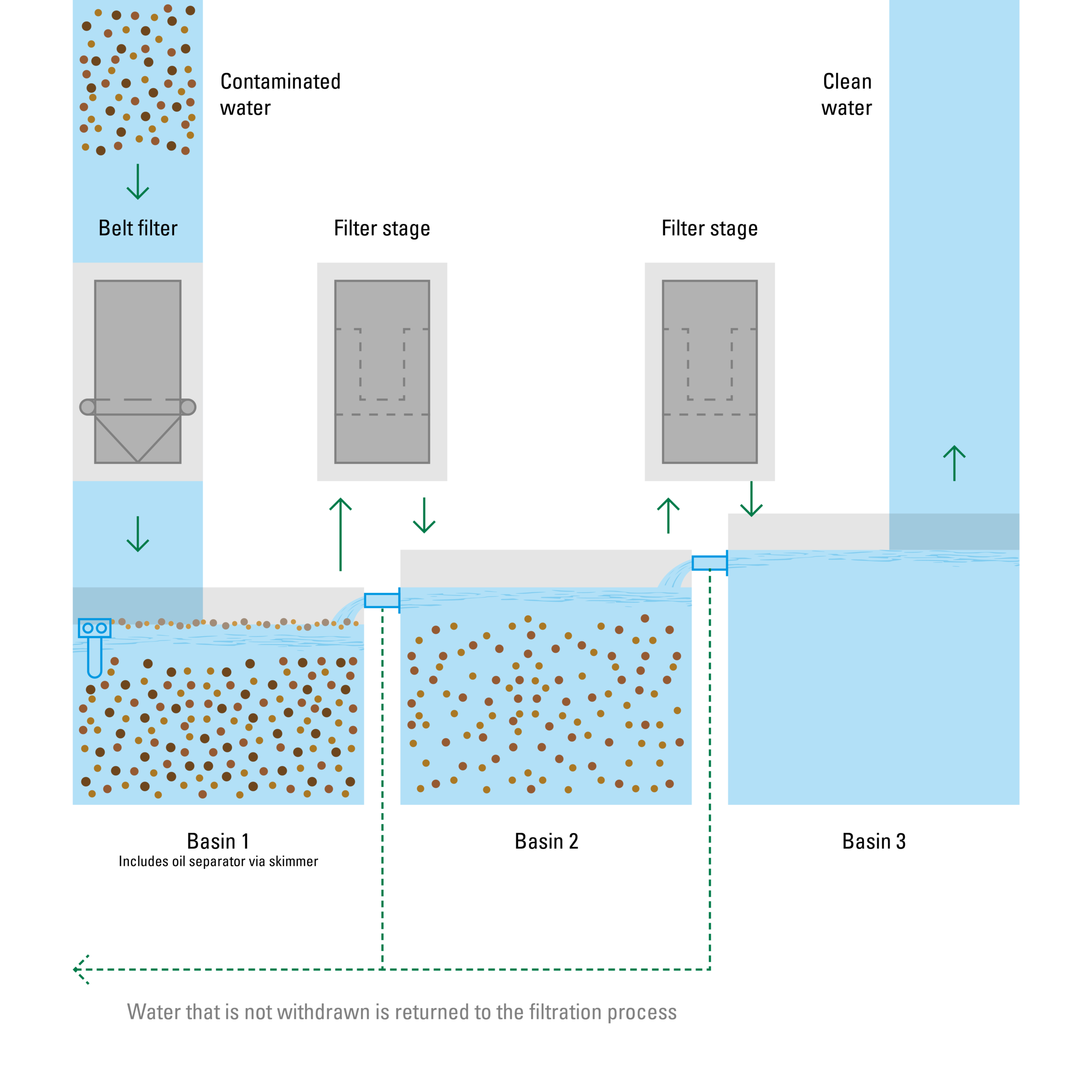
Here's how the processing works#.
Multi-stage Process Water Treatment
The contaminated process water passes through several coordinated stages. Coarse contaminants are removed early on to reduce the load on the downstream filters. This extends filter service life and lowers operating costs. The combination of stages used in each specific case depends on the particular application.
Stage 1: Prefiltration using a belt filter. Coarse contaminants such as chips and solids are reliably removed from the water.
Stage 2: Skimming the Water Surface Oils and fats that float to the surface are specifically removed using a skimmer before they can overload the fine filtration system.
Stage 3: Multi-stage fine filtration. The finest particles are progressively removed. Different filter types are used depending on the requirements. Additional filter types can be integrated for your application.
Upon request, we can supplement the treatment process with a controlled dosage of cleaning agents. An optional UV treatment extends the water’s service life before it is discharged.
Result: Treated process water of consistent quality, ready for reuse in the cycle.
Frequently Asked Questions (FAQ)
In industrial process water treatment, contaminated process water is purified in several stages and then returned to the production process. In a typical setup, a belt filter first removes coarse solids, after which a skimmer removes floating oils and fats. In the fine filtration stage, additional steps follow to trap the finest particles. The exact combination of steps depends on the specific application. The end result is clean process water of consistent quality that can be reused in the cycle.
In order for process water to be reused, it must be treated to the point where it once again meets the quality requirements of the respective process. A multi-stage treatment system removes solids, oils, fats, and fine particles. The treated water is then not discharged but fed directly back into the cycle. This reduces the need for fresh water and the volume of wastewater without compromising process quality.
Zero Liquid Discharge (ZLD) describes the goal of discharging as little liquid wastewater as possible into the environment. Process water is treated and kept in a closed loop, so that discharges are avoided as much as possible. For industrial companies, this means lower disposal costs and greater independence from fresh water sources. PURIMA’s solutions are designed according to this principle and help you close your water cycle as much as possible.
A typical system combines several stages. The process begins with a belt filter for pre-filtration of coarse contaminants. Next, a skimmer removes floating oils and fats. During fine filtration, the finest particles are retained, with different filter types used depending on the application. Additional filter types can be integrated as needed. We work with you to determine the exact sequence of stages based on your water and your quality goals.
Oils and fats float to the surface of the water and are removed by a skimmer. Coarse particles and chips are retained by the belt filter. The multi-stage fine filtration system, which uses different types of filters, removes even the finest suspended solids. Because the stages operate in this sequence, the load on each stage is reduced, which extends filter service life and ensures a consistently clean result.
A modular water treatment system is particularly worthwhile when large volumes of water are regularly contaminated, high costs for fresh water or wastewater disposal are incurred, or particles in the water cause wear and tear on the system’s equipment. Thanks to its modular design, the system can be precisely tailored to the degree of contamination and flow rate and expanded later as needed. This allows the solution to adapt to growing or changing requirements, rather than being oversized from the start.