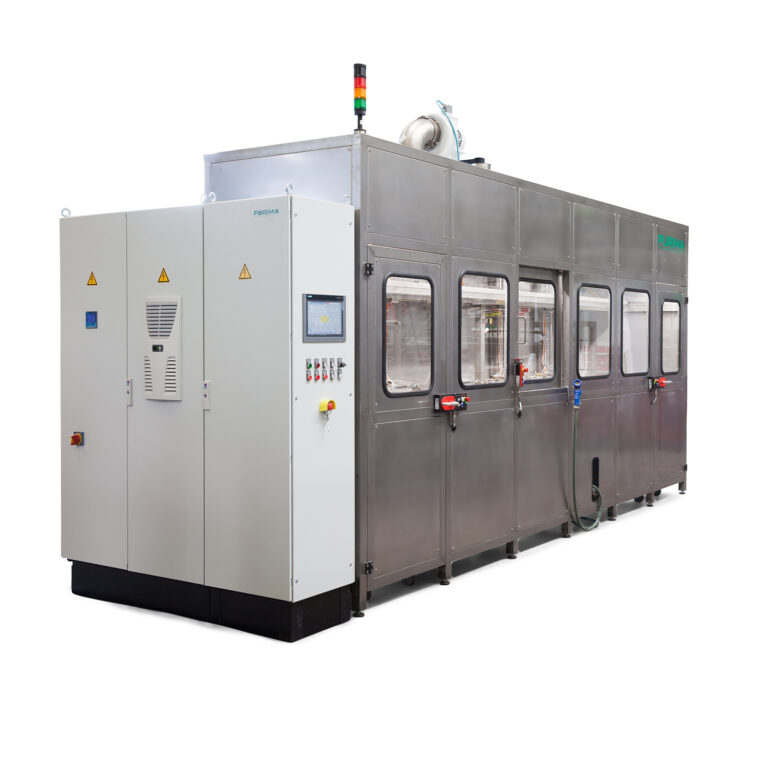
Spray cleaning
Encrustations and dried production residues on components are typical challenges addressed by the spray cleaning process step. The aqueous cleaning solution is sprayed directly onto the surface to be cleaned at a pressure of up to 25 bar using a nozzle or spray head. This can be done from any direction. The contaminants are either directly dislodged and washed away by the mechanical energy or softened so they can be completely removed in the subsequent cleaning step. To ensure uniform coverage, the items being cleaned are kept in motion using a material basket or movable nozzles. If particularly high cleanliness requirements must be met, the spray method is suitable as the final fine-cleaning stage in industrial cleaning systems. This ensures that 100 percent of any remaining particles are removed from the surface.
Immersion cleaning
Cleaning components in an immersion bath is one of the classic applications in the field of industrial parts cleaning. In immersion cleaning, the items to be cleaned are immersed in an aqueous alkaline or acidic degreasing solution and chemically treated there for a specified period of time. Here, too, the removal of contaminants can be improved by agitating the components: Rotation or oscillation within the baths ensures uniform distribution of the cleaning solution. The efficiency of immersion degreasing can also be increased by raising the bath temperature. The duration of the process also depends on the degree of soiling on the components to be cleaned. The process is simple, cost-effective, and gentle on sensitive surfaces: The cleaning effectiveness can be adjusted to the degree of soiling on your component by varying the factors mentioned above.
Pressure flooding
Contaminants such as chips and oils are found on workpieces immediately after grinding or cutting operations. In most cases, these must be removed during a pre-cleaning step. Pressure flushing is therefore configured as the first or one of the first process steps in many PURIMA systems. It represents a targeted combination of spray cleaning and ultrasonic cleaning. Nozzles or shower heads are arranged in the process tank in a specific configuration relative to the workpiece. The workpiece is treated underwater with pressures ranging from 3 to 15 bar and sound waves between 20 and 130 kHz . The interaction of pressure, sound, and volume generates high flow velocities in the cleaning tank, leading to cavitation in cavities and on surfaces. This results in an effective, vortex-like fluid exchange on the treated surfaces, even for complex workpieces. At the end of each cleaning process, depending on the process requirements and the desired results, drying and preservation can be easily integrated into our systems.